Echoes Without Inquiry
4/24/2026
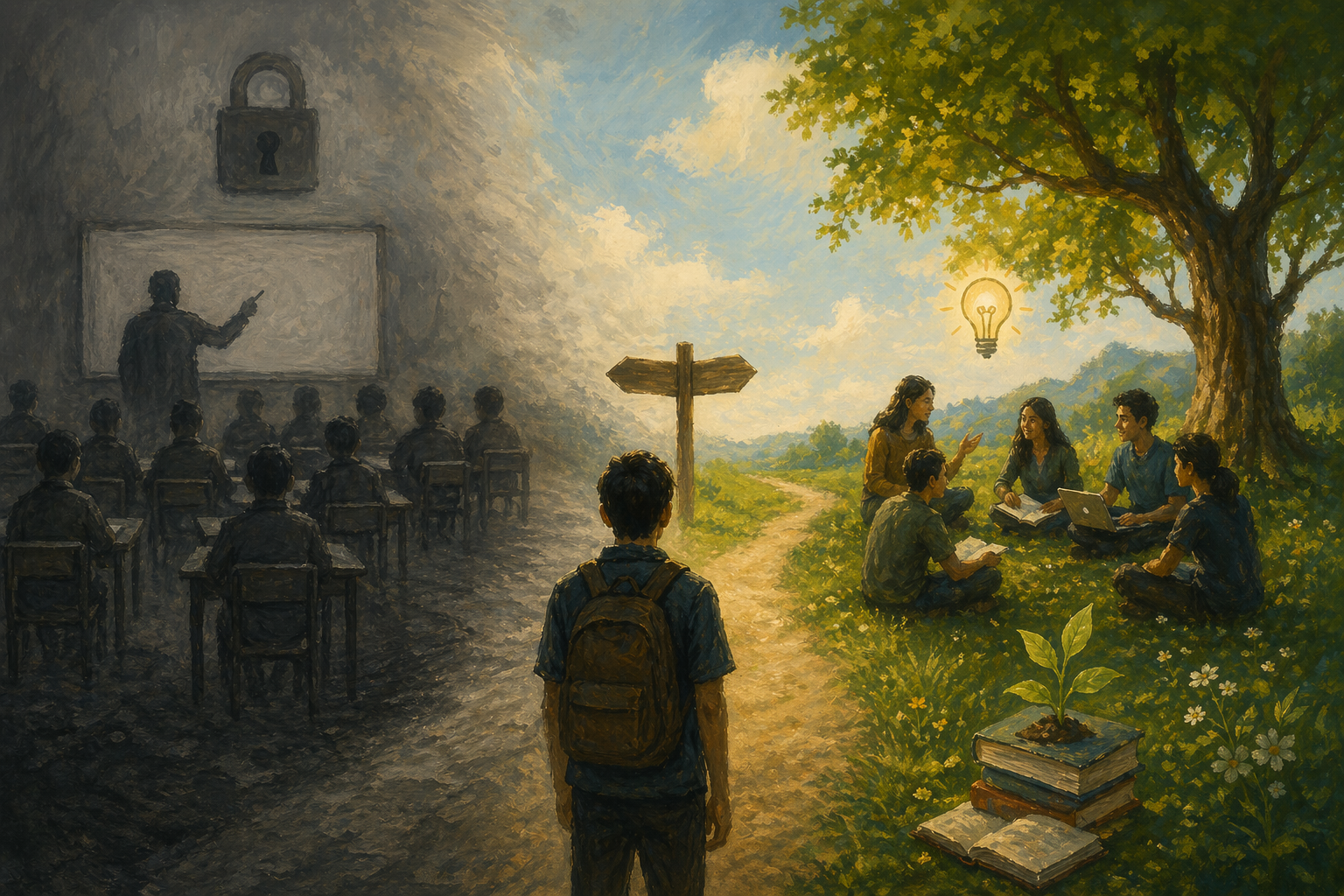
We live in a world full of answers, yet strangely empty of questions. People accept information quickly, react without thinking, and rarely ask why or how. Hence the title "Echoes Without Inquiry" because when echoes repeat without questioning, they multiply into confusion; and when confusion multiplies, it turns into chaos. And when chaos is left unchecked, it can become fatal. This is not accidental it reflects how learning/schooling itself has been shaped over time.
To understand this, it helps to begin with language. The word school comes from the Greek scholē, which originally meant "leisure" or "free time for learning." In its earliest sense, school was not about pressure, exams, or employment, but about space for thought, discussion, and intellectual exploration. It was a place where the mind was trained to understand the world, not simply to respond to it.
Alongside this idea, two important concepts define how teaching happens.
Pedagogy comes from the Greek paidos (child) and agogos (leader), meaning "to lead the child." It describes a system where learning is guided, structured, and controlled by a teacher.
In contrast, andragogy, from anēr/andros (adult) and agogos, means "leading adults," where learners are more self-directed, relying on experience, curiosity, and internal motivation.
Most traditional schooling systems are rooted in pedagogy, where students are positioned mainly as receivers of knowledge rather than active constructors of it.
This helps explain why many students go to school without deeply understanding why it exists. For many, the reason is simple and practical: they are sent there by their parents rather than choosing it themselves.
When asked, "Why do you go to school?", the answers are often habitual "because my parents told me," "to pass exams," or "to get a job in the future" rather than a deeper reflection on the purpose of education itself.
This disconnect is reinforced by how education is structured. Schools often prioritize memorization, standardized answers, and exam performance over exploration, conceptual understanding, and questioning.
Students are frequently given solutions before they fully understand the problems those solutions are meant to address. As a result, learning remains mostly pedagogical in practice, with limited movement toward andragogical learning where questioning and independent thinking take priority.
Higher education is often expected to represent independence and advanced thinking. However, in many cases, the teaching approach still strongly reflects a pedagogical model (still leading child).
Lectures dominate classrooms, instructors deliver information in a one-way flow, and students are frequently assessed based on memorization and reproduction of content rather than deep analysis or problem formulation.
Even at university level, students are often guided step-by-step toward expected answers, with limited space for open-ended inquiry, debate, or student-led exploration. In this sense, the system still carries forward the structure of "being taught" rather than "learning how to learn."
Historically, education had a very different context. In the time of many students’ parents or grandparents, formal schooling was rare, and access to knowledge was limited and difficult.
A single book could be shared among many students, passed from hand to hand in classrooms. Sometimes, entire lessons depended on copying what the teacher wrote on the board because textbooks were not available for everyone.
In that world, school represented access to scarce and valuable knowledge, and learning was tightly connected to authority and instruction.
Over time the purpose of schooling began to shift. Societies needed disciplined, literate, and organized workers, and education systems gradually became structured around standardization, time management, and measurable outcomes.
This is where the modern idea of school as a path to employment became dominant not as its original purpose, but as a historical adaptation to economic needs.
A country’s progress is ultimately reflected in the people who operate its core systems.
- Leaders guide national decisions
- Doctors protect health and life
- Engineers design infrastructure
- Mechanics sustain machinery and transport
- Psychologists support mental health
- Farmers ensure food security
- Teachers transmit knowledge
- Entrepreneurs create innovation and jobs
- etc...
Every field contributes to the structure of a nation. But behind all of these roles lies a common foundation: education.
Education shapes:
- how people think
- how they question
- how they collaborate
- how they respond to responsibility
- how they develop discipline, curiosity, and creativity
In this sense, education is not only a pathway to professions; it is the silent architect of the professionals themselves.
If education has such a profound influence on a country’s development, then improving education directly means accelerating national progress. In that sense, education becomes not just one sector among many, but the foundation that shapes all others.
Today, knowledge is no longer locked inside institutions. The internet has removed one of the biggest barriers in history: access to information.
Thus, the main challenge is no longer access to knowledge, but how we think about knowledge.
The central issue becomes:
How do we return education to curiosity, inquiry, and understanding?
Schools originally existed as spaces for thinking, not only producing answers. Reconnecting education to this purpose is essential.
In the near future, traditional institutions may evolve. Learning is becoming more decentralized due to technology. People can now learn skills online without formal classrooms.
However, institutions will not disappear quickly. They still provide:
- structure
- certification
- social organization
- guidance
Their role will likely transform gradually over time.
The first step is awareness: education is not just a degree or job pathway it is a system that shapes thinking.
This shift requires collective understanding and societal dialogue. Governments, educators, and public voices can all contribute to redefining education’s purpose.
Influential platforms and creators can also help spread this mindset to younger generations, making inquiry a cultural expectation rather than a rare trait.
For transformation to be real, it must enter daily education.
Teachers play a central role. Beyond teaching content, they should consistently emphasize:
- understanding
- questioning
- independent thinking
This is not a one-time reform. It is a long-term cultural shift that must be repeated across lessons, years, and generations.
Over time, this consistent reinforcement can reshape how students perceive learning. Not through force, but through repetition and experience.
Eventually, education may return closer to its original meaning: a space for thinking, not just answering
“Education is the most powerful weapon which you can use to change the world.” -- Nelson Mandela